Stand on almost any rooftop in Yogyakarta on a clear morning and you will find it in the north: a perfect cone with a thread of cloud at its tip. That is Merapi, one of the most active volcanoes in Indonesia, and the city has grown up in its shadow. Below it, between the mountain and the Indian Ocean, runs an old line drawn by the founders of the sultanate: from the volcano through the white Tugu monument, along Malioboro to the palace, and on to the sea.
Yogyakarta, which everyone here calls Jogja, is where Java keeps its traditions. It is still a sultanate, the only one in Indonesia whose sultan is also governor of the province, and the palace at its centre is a working royal household. Within an hour or so of the city stand two of the great monuments of Asia, Borobudur and Prambanan. And it is a student city too, full of cafés, galleries and street food, which keeps it young.
Why go
- Borobudur and Prambanan. The largest Buddhist temple in the world and the finest Hindu temple in Indonesia, both World Heritage Sites, both from the ninth century.
- A living kraton. The palace of the Sultan, with court dancers and gamelan in the mornings, and the old water garden of Taman Sari next door.
- Merapi. A volcano you can see from the city streets, with green villages on its lower slopes.
- Craft and food. Batik and silver workshops, the sweet jackfruit stew called gudeg, and evenings on Malioboro.
In 2023 UNESCO added the line from Merapi to the sea, the Cosmological Axis of Yogyakarta, to its World Heritage list, with its landmarks from the Tugu to the Kraton. Walking it is the best way to understand how the city was laid out.
The Kraton, Taman Sari and the old city
The Kraton, the Sultan's palace, opens to visitors from Tuesday to Sunday, 08:30 to 14:30, and is closed on Mondays. In 2026 a ticket for foreign adults cost Rp25,000. From Tuesday to Sunday there are performances of dance or gamelan in the Srimanganti pavilion between 09:00 and 11:00, which is the moment to come. This is a royal home, so dress with care: sleeves, nothing short, no hats in the museum rooms, and photographs only where the staff allow them.
A few minutes' walk away is Taman Sari, the eighteenth century water garden of the sultans, open every day from 09:00 to 15:00 for a small fee. Its bathing pools are the famous part, but the real pleasure is the maze of narrow lanes around it, where families live among the old walls.
Malioboro, the long street north of the palace, closes to motor traffic every evening from 17:00 to 22:00, leaving it to walkers, becak, horse carts and the city's buses. The province has been working on making it fully pedestrian, but in November 2026 it postponed the change, so expect the evening rule for now. South east of the centre, Kotagede, the old capital of the Mataram kingdom, is quieter: walled lanes, an old mosque and the workshops of silversmiths who still work by hand.
Borobudur
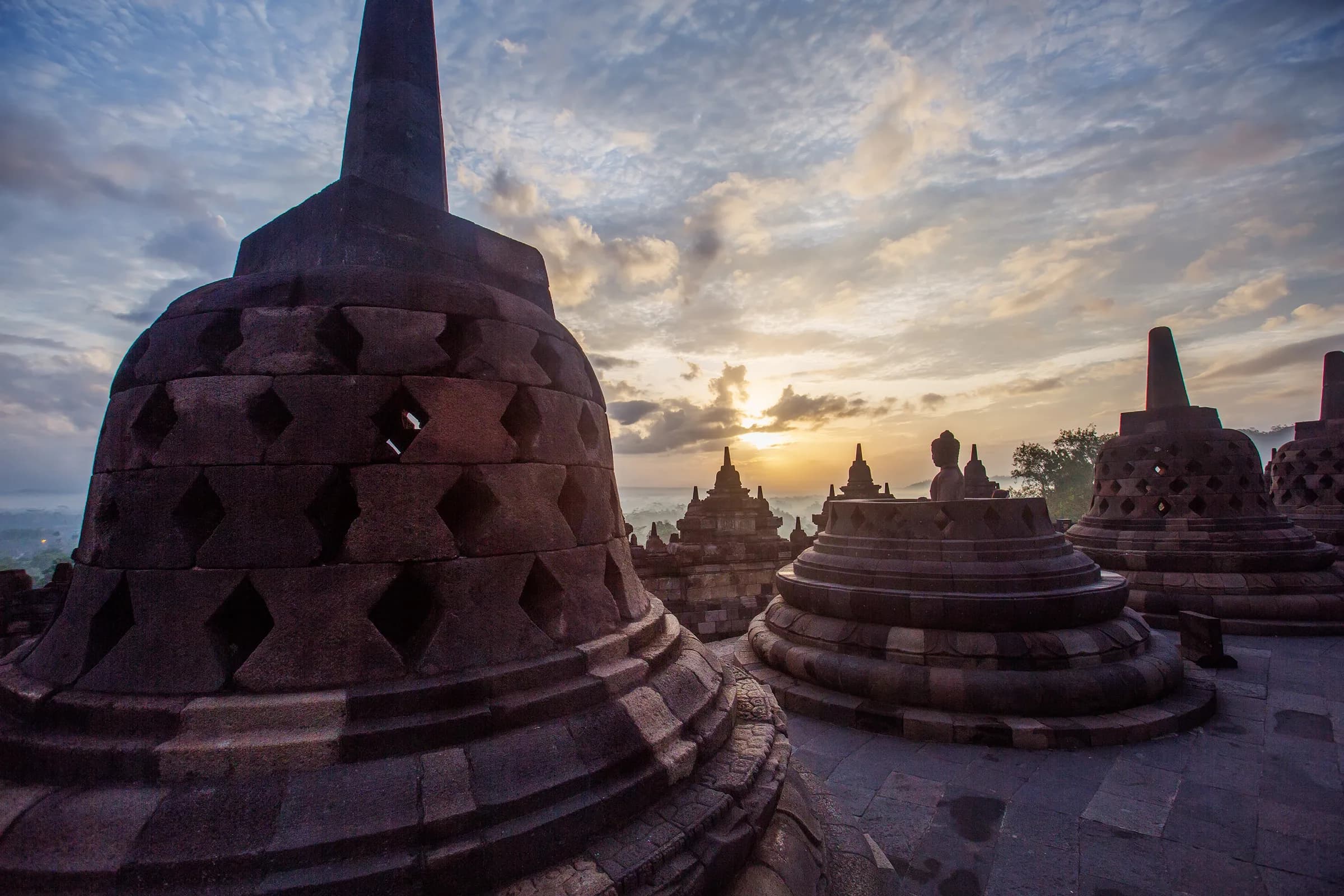
Borobudur is not in Yogyakarta province but just over the border in Magelang, Central Java, about 40 kilometres northwest, so allow an hour to an hour and a half by road. It is a mountain of carved stone in nine terraces, with more than 2,600 relief panels and 72 stupas on the top, and the best known image of the island.
How you visit has changed since the climb reopened in 2023. Foreign visitors buy the ticket that includes going up onto the temple, sold in timed sessions through the day. In 2026 it cost Rp455,000 for adults and Rp305,000 for children aged 3 to 10, and it includes a local guide and a pair of upanat, woven sandals that protect the stone, which you keep. The number of climbers each day is capped, so book on the official ticket site a few days ahead and arrive 30 to 45 minutes before your session. There is also a sunrise visit from 04:00 for Rp1,000,000, limited to 100 people a day, with breakfast afterwards.
Borobudur is busiest during Waisak, the Buddhist festival of the full moon, on 20 May in 2027, when access changes for the ceremonies.
Prambanan and Ratu Boko
Prambanan, about 17 kilometres east of the city, is the other side of Java's old faith: a cluster of slender Hindu towers to Shiva, Vishnu and Brahma, carved with the story of the Ramayana. It opens daily from 06:30, and the ticket, about Rp400,000 for foreign adults in 2026, also covers the smaller temples of Lumbung, Bubrah and Sewu nearby. On Mondays the main temples close for maintenance; the gardens, the museum and Lumbung, Bubrah and Sewu stay open. It closes for Nyepi, the Hindu day of silence, which falls on 8 March in 2027. The commuter train to Solo stops at Brambanan station, a short ride away.
On a hill to the south, the ruined palace of Ratu Boko is best at the end of the day, when the light falls through its great gateway; a foreign ticket cost Rp275,000 in 2026.
In the evening, stay for the Ramayana ballet, performed on the open-air stage with the temples lit up behind it. In 2026 the full open-air show ran on Tuesdays, Thursdays and Saturdays at 19:30 from May to December, with a shorter Saturday show, also in the open air, on the amphitheatre stage from January to April. If rain stops it after the scene of Hanuman burning the city, the show counts as finished, so pick a dry evening if you can.
Borobudur, Prambanan and Yogyakarta tours

Viator

Klook
Affiliate links: we may earn a commission if you book, at no extra cost to you.
Merapi and the south coast
Merapi has been at alert Level III, the second highest, for years, and in November 2026 it was still sending glowing rockfalls down its southwest flank. The summit is closed, and the danger zones reach up to 7 kilometres from the peak on the southwest side and 5 kilometres on the southeast. The settlements and visitor spots outside those zones stay open: the hill resort of Kaliurang is cooler than the city and has views of the mountain on clear mornings. Jeep tours on the lower slopes run when the volcano observatory allows them; check the day's status before you go and follow the rules on the ground.
To the south, an hour from the city, Parangtritis is a long beach of dark sand facing the Indian Ocean, beautiful at sunset and dangerous in the water. Rescue teams have mapped strong rip currents along this coast, and people drown here every year, visitors among them. Walk, watch and keep out of the sea.
How do you get to Yogyakarta?
- By air. Yogyakarta International Airport (YIA) is in Kulon Progo, about 45 kilometres west of the city, with direct flights from Bali in about an hour and a half and from Jakarta and other cities. The airport train, run by KAI Commuter since September 2026, reaches the main station in about 40 minutes, from Rp20,000 on the regular service and Rp50,000 on the express.
- By train from Jakarta. Executive trains from Gambir reach Yogyakarta's Tugu station in about six to six and a half hours; cheaper trains from Pasar Senen often stop at Lempuyangan and take longer. From 16 December 2026, a new daily train, the KA Borobudur, runs between Gambir and Lempuyangan in both directions, at Rp380,000 in economy or Rp650,000 in executive class for the whole route, as KAI announced in November. From Surabaya it is about four hours.
- Overland from Bali. Cross from Gilimanuk to Ketapang by ferry, then take a train from Banyuwangi: about 11 hours on the Wijayakusuma, longer in economy. Our guide from Bali to Ijen covers the crossing, and you can break the journey at Ijen and Mount Bromo; our route from Bromo to Ijen runs it in the other direction. Long-distance buses from Denpasar take 17 to 20 hours.
Trains, buses and flights to Yogyakarta

12Go
12Go
Affiliate links: we may earn a commission if you book, at no extra cost to you.
Getting around is easy. Ride-hailing apps work everywhere, the Trans Jogja buses cost Rp2,700 with a card, and the commuter line to Solo, a flat Rp8,000, links the main station with Prambanan and the royal city of Solo. Yogyakarta is on Western Indonesia Time (WIB), one hour behind Bali.
Car with driver for Borobudur and Prambanan
Klook
6, 10 or 12 hours, or from YIA airport
Viator
A full day, about 12 hours
Affiliate links: we may earn a commission if you book, at no extra cost to you.
When to go and how long to stay
The dry season, roughly April to October, brings clearer mornings at the temples, the best views of Merapi and the full open-air Ramayana season. The wet season, from about November to March, means afternoon downpours, but mornings are often fine and the countryside is a brilliant green. The city fills up around Idul Fitri (around 10 and 11 March in 2027), during Indonesian school holidays in late June and July and at the end of the year, and on long weekends.
Give Yogyakarta three or four days: one for the Kraton and the old city, one for Borobudur, one for Prambanan with the ballet in the evening, and a fourth for Merapi, Kotagede or simply wandering. From here, many travellers head east by train towards Bromo and Ijen, then on to Bali and Lombok.
Where to sleep in Yogyakarta

Agoda

Booking.com
Affiliate links: we may earn a commission if you book, at no extra cost to you.
Before you fly

Airalo

SafetyWing
Affiliate links: we may earn a commission if you book, at no extra cost to you.