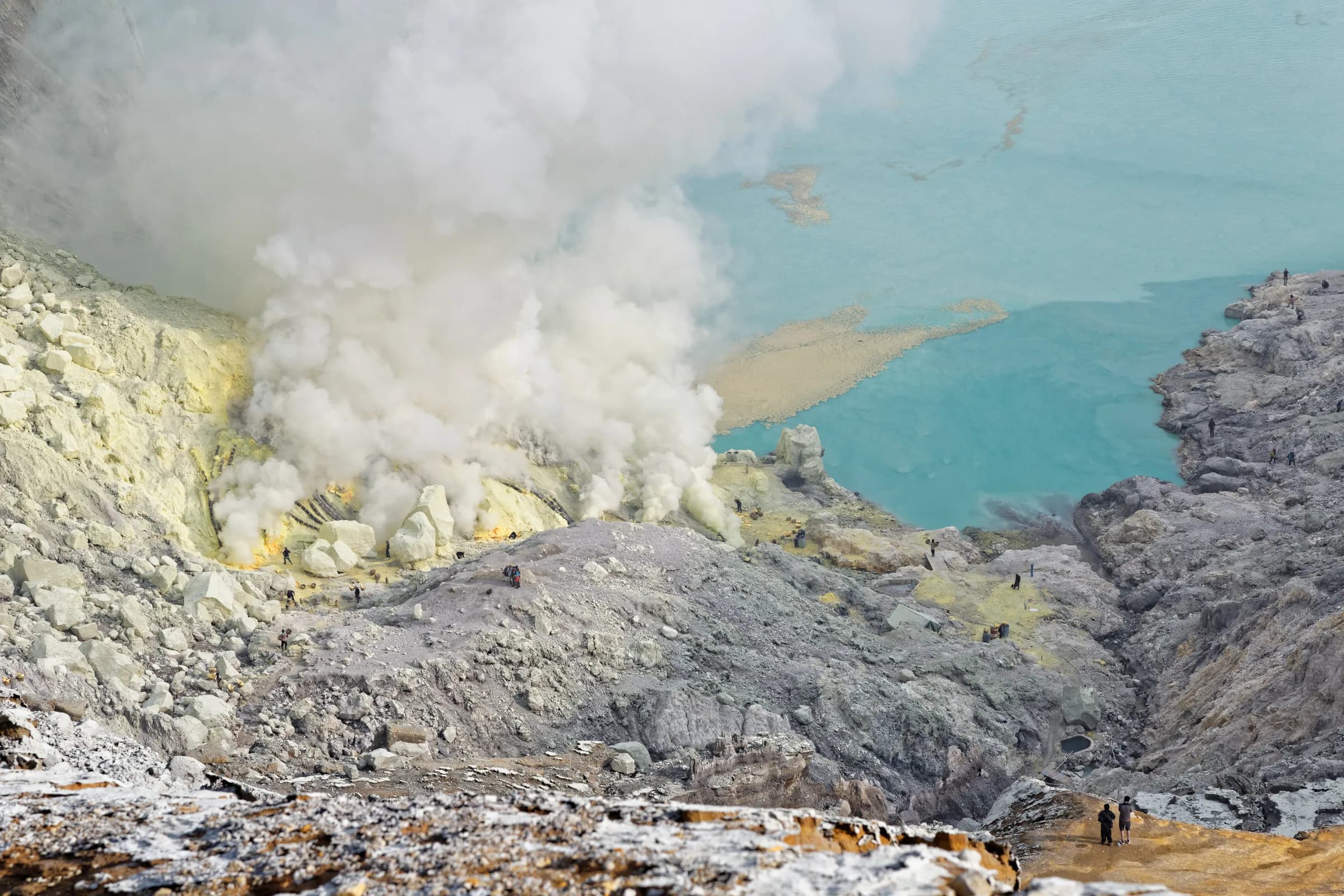
Ijen is a volcano at the eastern tip of Java, on the border of Banyuwangi and Bondowoso regencies, and its crater is one of the strangest places you can walk to in Indonesia. More than 2,300 metres up, a turquoise lake fills the bottom of the crater while sulphur smokes from vents along one shore. Most people see it at dawn, after a night hike from Paltuding, the trailhead.
Why go
- The lake. About a kilometre across and up to 200 metres deep, it is described by NASA as the largest highly acidic crater lake in the world.
- Sunrise from the rim. The hike is timed so you reach the crater edge in the dark and watch the light come up over the water and the smoking vents.
- A working mountain. Sulphur has been carried out of this crater by hand for more than half a century. The story of the men who carry it is part of why the place stays with people.
- A protected landscape. Ijen is the heart of the Ijen Geopark, recognised as a UNESCO Global Geopark in May 2023.
The crater lake
The colour is chemistry: hydrochloric and sulphuric acids dissolved in the water turn it a milky turquoise. Measurements of its acidity vary between sources, from a pH of around 0.5 to below zero, far beyond anything you would want to touch. Echo-sounding surveys in 2010 and 2011 put the lake at roughly 1,000 by 600 metres, holding about 27.5 million cubic metres of water.
What about the blue fire?
The famous blue flames are sulphur gas escaping from cracks in the crater floor and burning as it meets the air. They only show in the dark, roughly between 2 and 4 am.
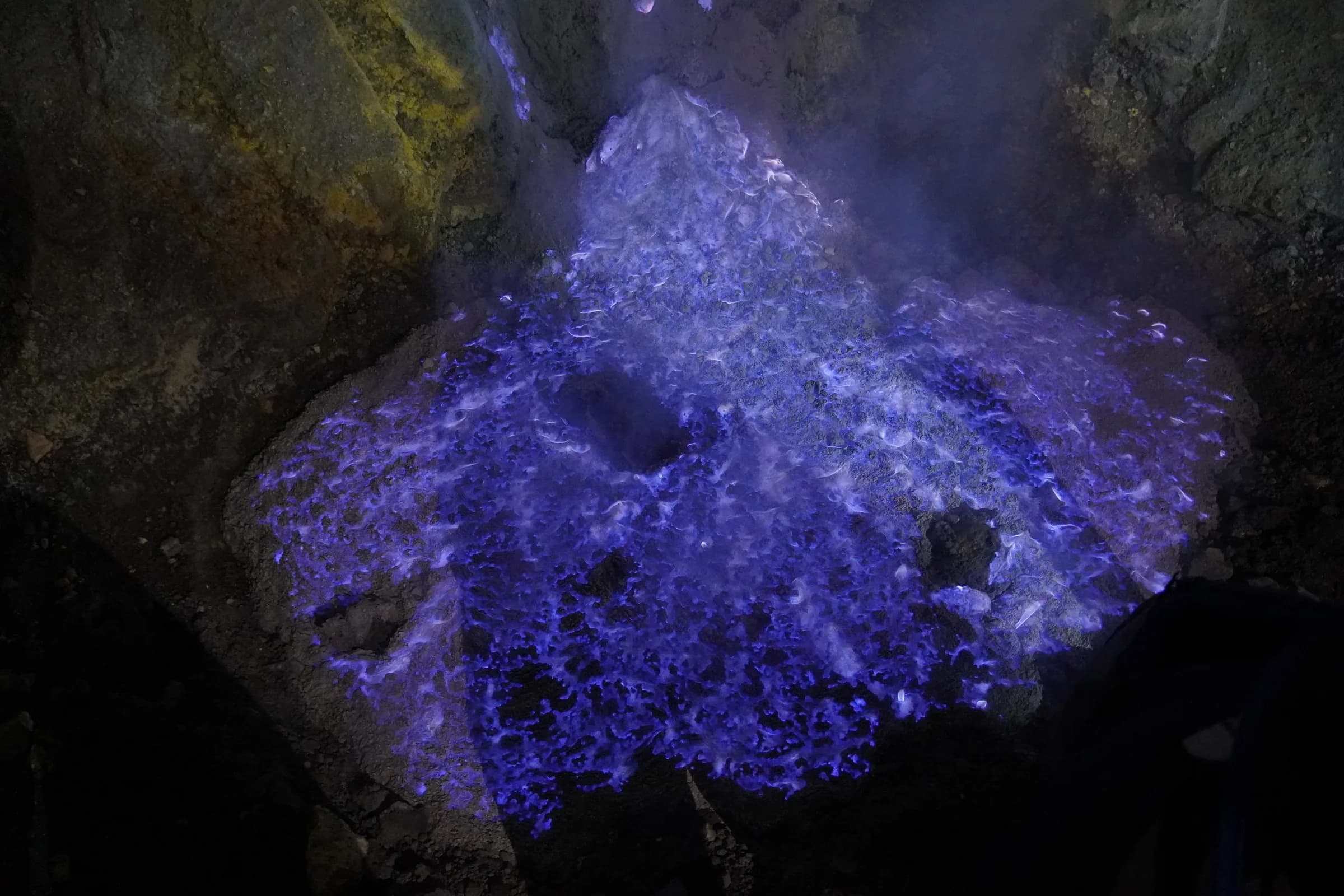
Seeing them up close is another matter. A 2024 circular from the park authority asks visitors to keep back from the crater's edge, not to go down to the crater floor, and not to stay overnight within 500 metres of the crater; reports in 2026 say the crater floor is still closed to visitors. Since late 2025 local reports have said that access to the blue fire is closed and that the flames have dimmed, partly because fewer miners now tend the gas pipes. Some visitors still describe going down, but treat any tour that promises the blue fire with care, and go for the lake and the sunrise instead.
How to visit
- Hours. The hiking gate opens at 2 am and closes at noon (WIB).
- Tickets. Sold online only, through the Ministry of Forestry's AyoKeTamanNasional site. They cannot be cancelled, moved or refunded, and the name must match your passport. The foreign visitor price reported from October 2024 was Rp150,000 per person; check the current price when you book.
- Health certificate. Every hiker needs a doctor's letter issued no more than three days before the visit. People with heart disease, asthma or other breathing problems are advised not to climb.
- The walk. Paltuding to the rim is three to four kilometres, steep and sandy in places, and takes most people two to three hours. Bring a torch, a proper mask for the sulphur gas, warm layers and shoes with grip.
When is Ijen closed?
The park closes on the first Friday of every month for Ijen Rijik, a clean-up day. Check the calendar before you book. It can also close without warning for weather or volcanic activity, as it did from 4 to 27 September 2026, when a forest fire burned on its slopes: read about that closure.
Indonesia's volcanology agency rates Ijen's activity on a four-level scale, from Level I (normal) to Level IV (danger). Check the current level on MAGMA Indonesia before you go.
When to go
The dry season, roughly April to October, gives the best chance of clear skies at dawn. Whatever the month, it is cold at the rim before sunrise: around 10°C, and it can drop to about 2°C.
How do you get to Ijen?
Most visitors come from Bali by ferry and stay a night in Banyuwangi, the nearest town; our guide to where to stay near Ijen compares it with bases closer to the trailhead. Our guide to getting from Bali to Ijen covers the ferry, the time change and the ways to reach the trailhead.