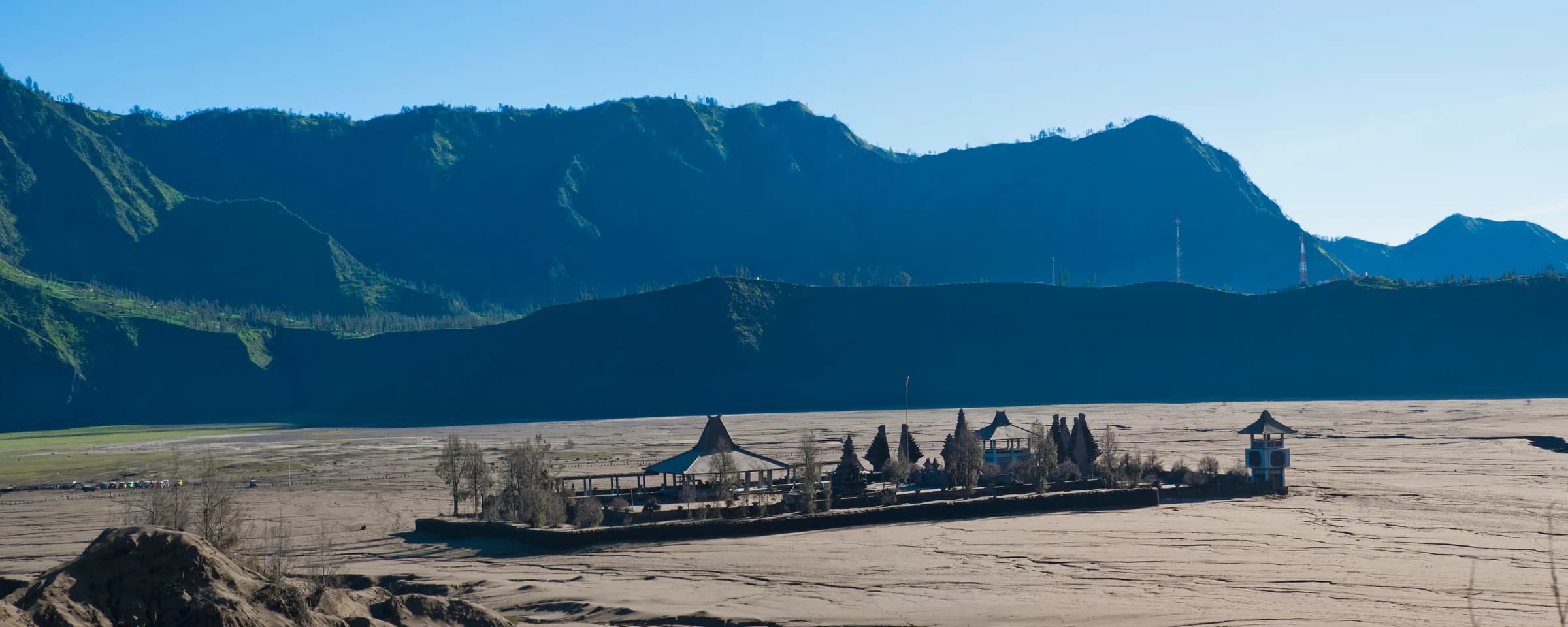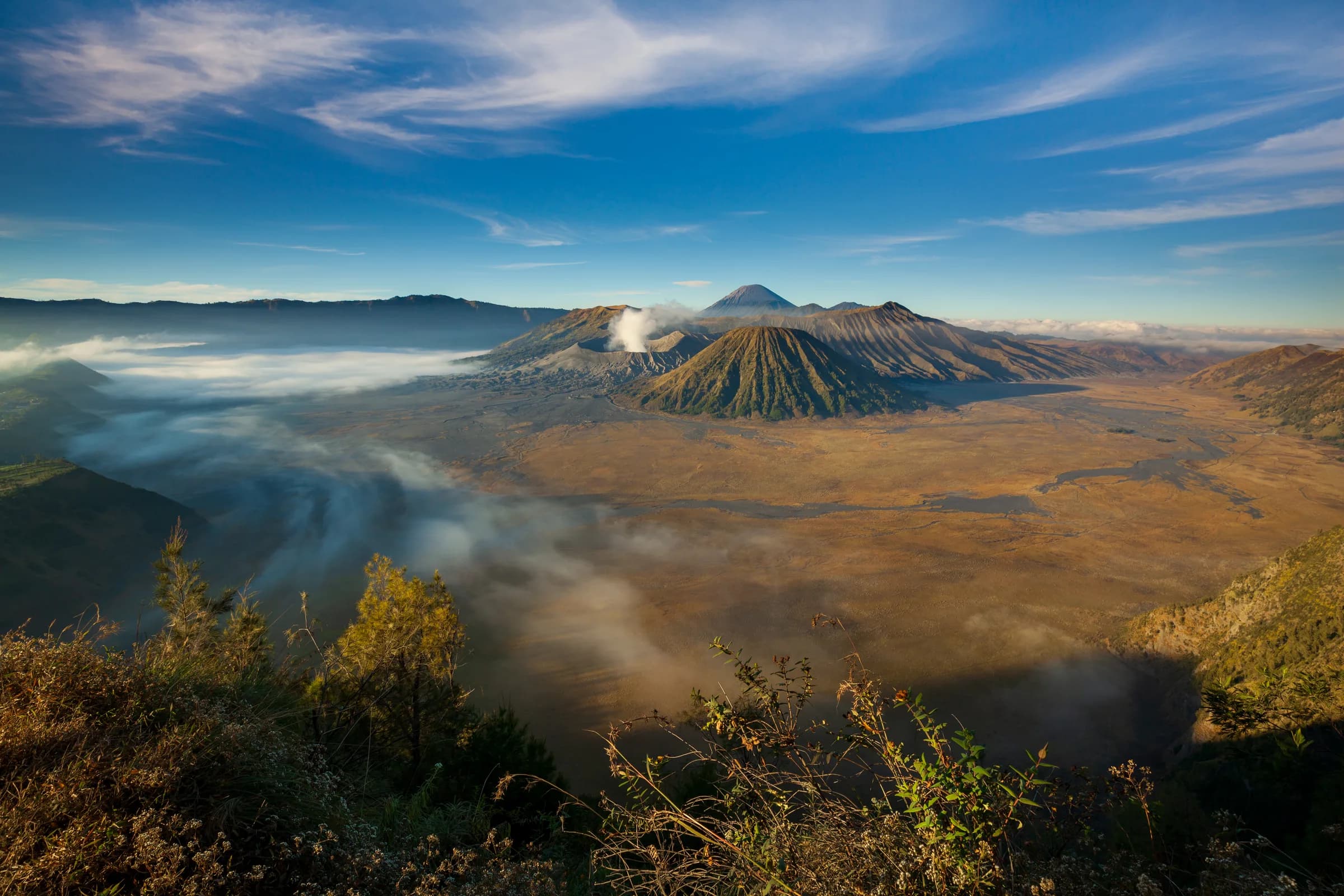
Long before dawn, a line of headlights crawls up the rim of the Tengger caldera. Jeeps park nose to tail, people in borrowed jackets stamp their feet in the cold, and for a while there is nothing to see at all. Then the light comes, and the reason for the alarm at two in the morning appears all at once: a plain of grey sand far below, a small volcano breathing white smoke in the middle of it, and on a clear morning the perfect cone of Semeru, Java's highest mountain, standing behind.
That volcano is Bromo. At around 2,300 metres it is not tall by Javanese standards, but few places in Indonesia look so much like another planet, and it is the heart of Bromo Tengger Semeru National Park, which spreads across four regencies of East Java.
Can you visit Bromo right now?
Yes, but not all of it. On the afternoon of 5 November 2026 Bromo erupted, sending a column of ash about 500 metres above the summit. Indonesia's volcanology agency raised the alert from normal to Level II, and nobody may go within one kilometre of the active crater. That rules out the most famous walk at Bromo, the stairs up to the crater rim.
The park itself stayed open. The sunrise viewpoints at Penanjakan, the sea of sand, the savanna of Lembah Watangan and the hills of Bukit Kedaluh and Lemah Pasar were all open in the days after the eruption, with rangers marking the safe limit on the ground. The park authority has asked visitors not to push towards the crater for a better view or a photo. Small eruptions can follow without warning, so check the current alert level on MAGMA Indonesia and the park's own announcements before you travel, and expect the rules to change in either direction.
Why go
- Sunrise from the rim. From the viewpoints on the caldera edge you watch the sand sea fill with light, Bromo smoking in front of you and Semeru behind. It is the picture that made Bromo famous, and travellers say the real view lives up to it.
- The sea of sand. The floor of the caldera is a flat plain of volcanic sand, several kilometres across, which you cross by jeep, on horseback or on foot. In the early morning mist it is eerily quiet.
- A living culture. The Tengger people, who farm the steep slopes around the caldera, keep a Hindu faith of their own. Their temple, Pura Luhur Poten, stands alone on the sand at the foot of Bromo, and once a year they climb to the crater with offerings for Yadnya Kasada.
- The green side. South of the volcano the sand gives way to the soft green hills of Lembah Watangan, a savanna that tours long sold as Bukit Teletubbies; in 2024 the park and Tengger elders restored its old name.
Where do you watch the sunrise?
Most jeeps head for Penanjakan, the highest viewpoint, at more than 2,700 metres on the Pasuruan side of the caldera. It has the widest view and the biggest crowds; on busy weekends the last stretch is a walk past a long line of parked jeeps. Bukit Kedaluh and Lemah Pasar, lower down the same road (signposted for years as King Kong Hill and Bukit Cinta), see the same scene from a slightly different angle with fewer people. Jeeps usually leave Cemoro Lawang around 3 am to be in place before first light.
After sunrise, the classic loop drops down into the caldera to the sea of sand and Pura Luhur Poten, and on to the savanna. While the crater zone is closed, ask your driver which stops are open that day.
The crater, when it is open
In normal times the walk from the sand to the crater rim is short and steep: a sandy path, then about 250 concrete steps. At the top you look straight down into a smoking hole, and the roar of the gas comes up with the smell of sulphur. It is a narrow rim with little to hold on to, and the ash can sting your eyes. People with breathing problems should think twice, and everyone should bring a mask.
It is also sacred ground. During Yadnya Kasada the Tengger throw offerings of crops, flowers and livestock into the crater, and at any time of year you may see small offerings left on the steps. Treat them as you would anything in a temple. Our story on the Tengger and their night of Yadnya Kasada tells who they are and how that night unfolds, from the temple in the sand sea to the crater.
How to visit
- Tickets. Sold online only, through the park's booking site, bookingbromo.bromotenggersemeru.org, and checked by QR code at the gates. Since 30 October 2024 the price for foreign visitors has been Rp255,000 per person per day, weekdays and holidays alike, insurance included. Anyone found without a ticket pays five times the normal price.
- A daily limit. The park caps the number of visitors, at 2,752 a day in October 2026, so book ahead for weekends and Indonesian holidays.
- Jeeps. The ticket does not include transport. Most visitors hire a four-wheel drive with a driver for the night, from Cemoro Lawang or the villages around it. Prices are set locally and change with the route and the season, so agree on the price, the stops and the start time before you go. You can also walk from Cemoro Lawang down to the sand and back without a jeep.
- No fire, of any kind. Smoking on the trails, campfires and flares are banned. In 2023 a flare lit for a wedding photo shoot set the savanna alight, and the organiser of the shoot was sentenced to prison. The dry grass burns fast, and fires are the reason the park closes most often.
- Dress for the cold. It is properly cold on the rim before sunrise. Bring warm layers, a hat and gloves; guesthouses in Cemoro Lawang rent thick jackets if you arrive unprepared.
If you would rather not arrange the jeep and the night drive yourself, a sunrise tour from Malang or Surabaya takes care of both.
Bromo sunrise tours

Viator

Klook
Affiliate links: we may earn a commission if you book, at no extra cost to you.
When is Bromo closed?
The park closes for a few days every year around Yadnya Kasada, the Tengger offering ceremony, whose date follows their own calendar: in 2026 it was shut from 30 May to 2 June. It also closes on Nyepi, the Hindu day of silence, and occasionally for a week of rest to let the ecosystem recover, as it did from 6 to 12 April 2026. In the Tengger month of Wulan Kapitu it closes twice more: from 17:00 on 8 December to the end of 9 December 2026, and from 17:00 on 6 January to the end of 7 January 2027 (dates and roads).
The unplanned closures matter more. Fires closed the whole park in August and again in September 2026, and the Penanjakan viewpoints only reopened on 23 October. Eruptions can close the crater zone, or more, at short notice. Tickets for closed days can usually be moved or refunded, but check the park's announcements in the week before you go.
When to go
The dry season, roughly April to October, brings the clearest sunrises. The end of it is also fire season, when closures are most likely, so leave yourself a spare morning if Bromo is the reason for your trip. In the wet season mornings are often cloudier, but the caldera turns green and the crowds thin out. Weekends and Indonesian school holidays are always the busiest.
How do you get to Bromo?
There are three main gateways. Cemoro Lawang, on the Probolinggo side, sits right on the caldera rim and has the most guesthouses; most visitors stay here. Wonokitri and Tosari, on the Pasuruan side, are the closest villages to Penanjakan. From Malang, jeeps come in from the south through Tumpang, which suits people already staying in the city.
By road, Cemoro Lawang is about three to four hours from Surabaya. Without a car, take the train to Probolinggo, then a minibus up the mountain, about an hour and a half more. Many travellers carry on east from Bromo to Ijen and then to Bali; our guide to Ijen Crater covers the next volcano on that road. Our Bromo to Ijen guide compares the drive and the train, with the times.
Where to sleep near Bromo

Booking.com
Agoda
Affiliate links: we may earn a commission if you book, at no extra cost to you.